Velocity and Acceleration — Question 4

PDF ↗

Question 4

For the helix r→(t)=⟨3cost,3sint,4t⟩\vec r(t)=\left\langle 3\cos t,3\sin t,4t\right\rangle, find velocity and acceleration. Prove that its speed is constant and decide whether acceleration is entirely normal.

Original worksheet page 1: question and worked solution for 6-11-004
Show solutionHide solution

Question 4 – Solution

Strategy Compute v→⋅a→\vec v\cdot\vec a after differentiating.

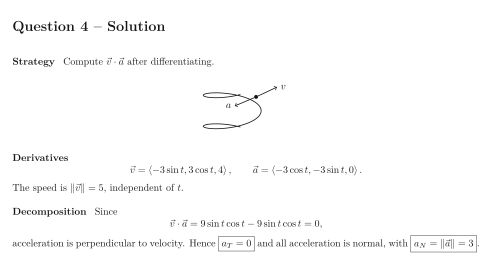
See the diagram in the original worksheet below.

Derivatives v→=⟨−3sint,3cost,4⟩,a→=⟨−3cost,−3sint,0⟩.\vec v=\left\langle -3\sin t,3\cos t,4\right\rangle,\qquad \vec a=\left\langle -3\cos t,-3\sin t,0\right\rangle. The speed is ∥v→∥=5\|\vec v\|=5, independent of tt.

Decomposition Since v→⋅a→=9sin⁡tcos⁡t−9sin⁡tcos⁡t=0,\vec v\cdot\vec a=9\sin t\cos t-9\sin t\cos t=0, acceleration is perpendicular to velocity. Hence aT=0\boxed{a_T=0} and all acceleration is normal, with aN=∥a→∥=3\boxed{a_N=\|\vec a\|=3}.

Original worksheet page 2: question and worked solution for 6-11-004

Original worksheet layout. Use Enlarge or open the PDF for a closer view.