Question 4
The points , , and form a triangle. Classify it as scalene, isosceles, or equilateral, and determine whether it is acute, right, or obtuse.

Show solutionHide solution
Question 4 – Solution
Strategy Compare squared side lengths; this avoids unnecessary square roots. The converse of the Pythagorean theorem classifies the largest angle.
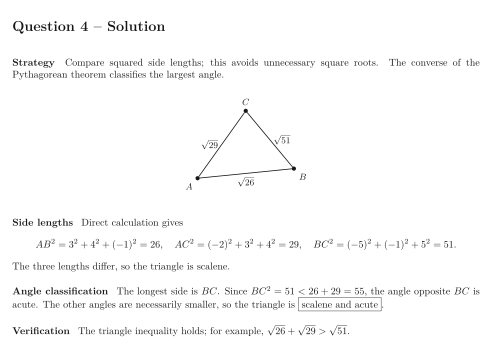
See the diagram in the original worksheet below.
Side lengths Direct calculation gives The three lengths differ, so the triangle is scalene.
Angle classification The longest side is . Since , the angle opposite is acute. The other angles are necessarily smaller, so the triangle is .
Verification The triangle inequality holds; for example, .