Question 5
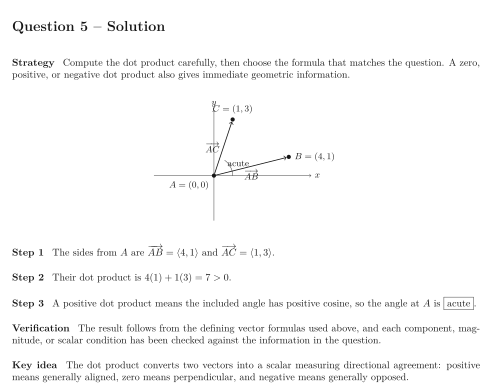
Determine whether the triangle with vertices , , and has an acute, right, or obtuse angle at .

Show solutionHide solution
Question 5 – Solution
Compute the dot product carefully, then choose the formula that matches the question. A zero, positive, or negative dot product also gives immediate geometric information.
See the diagram in the original worksheet below.
The sides from are and .
Their dot product is .
A positive dot product means the included angle has positive cosine, so the angle at is .
The result follows from the defining vector formulas used above, and each component, magnitude, or scalar condition has been checked against the information in the question.
The dot product converts two vectors into a scalar measuring directional agreement: positive means generally aligned, zero means perpendicular, and negative means generally opposed.