Question 8
Determine whether and represent the same direction, opposite directions, or neither. Explain.

Show solutionHide solution
Question 8 – Solution
Identify the initial and terminal information first. Build the vector by subtracting coordinates, then use the magnitude formula or normalize only after the components are correct.
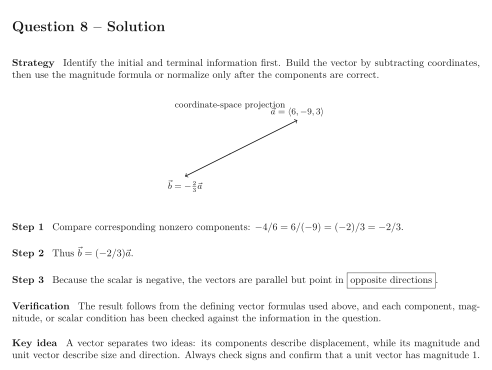
See the diagram in the original worksheet below.
Compare corresponding nonzero components: .
Thus .
Because the scalar is negative, the vectors are parallel but point in .
The result follows from the defining vector formulas used above, and each component, magnitude, or scalar condition has been checked against the information in the question.
A vector separates two ideas: its components describe displacement, while its magnitude and unit vector describe size and direction. Always check signs and confirm that a unit vector has magnitude .