Question 5
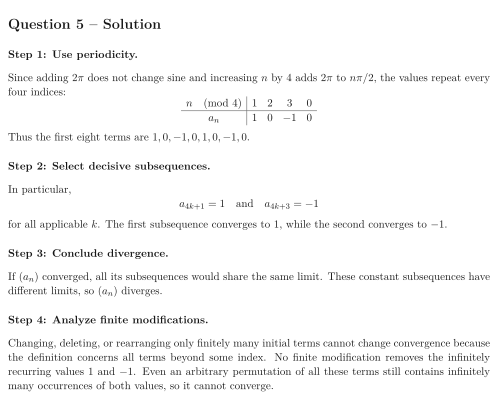
Let for .
Make a table giving for each residue class of modulo , and list the first eight terms.
Determine whether the sequence converges. Justify your answer using subsequences.
Explain whether changing or rearranging finitely many initial terms can change convergence.
Show solutionHide solution
Question 5 – Solution
Step 1: Use periodicity.
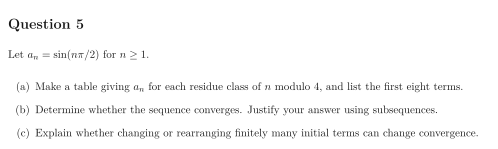
Since adding does not change sine and increasing by adds to , the values repeat every four indices: Thus the first eight terms are .
Step 2: Select decisive subsequences.
In particular, for all applicable . The first subsequence converges to , while the second converges to .
Step 3: Conclude divergence.
If converged, all its subsequences would share the same limit. These constant subsequences have different limits, so diverges.
Step 4: Analyze finite modifications.
Changing, deleting, or rearranging only finitely many initial terms cannot change convergence because the definition concerns all terms beyond some index. No finite modification removes the infinitely recurring values and . Even an arbitrary permutation of all these terms still contains infinitely many occurrences of both values, so it cannot converge.