Optimization — Question 5

PDF ↗

Question 5

A square and an equilateral triangle are to be constructed from a single wire 100 cm long. The square and the triangle do not overlap. How much wire should be used for each shape in order to minimize the total enclosed area?

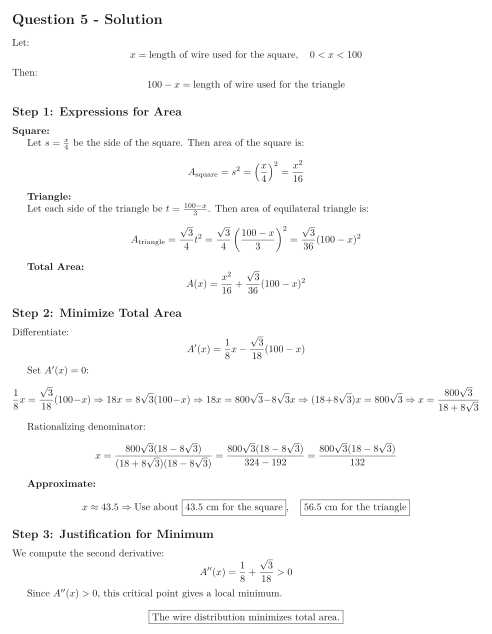
See the diagram in the original worksheet below.

Original worksheet page 1: question and worked solution for 4-8-005
Show solutionHide solution

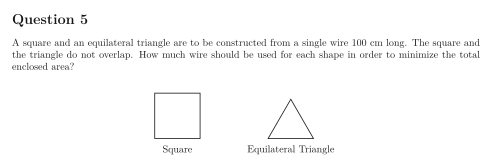
Question 5 - Solution

Let: x=length of wire used for the square,0<x<100x = \text{length of wire used for the square}, \quad 0 < x < 100 Then: 100−x=length of wire used for the triangle100 - x = \text{length of wire used for the triangle}

Step 1: Expressions for Area

Square:

Let s=x4s = \frac{x}{4} be the side of the square. Then area of the square is: Asquare=s2=(x4)2=x216A_{\text{square}} = s^2 = \left(\frac{x}{4}\right)^2 = \frac{x^2}{16}

Triangle:

Let each side of the triangle be t=100−x3t = \frac{100 - x}{3}. Then area of equilateral triangle is: Atriangle=34t2=34(100−x3)2=336(100−x)2A_{\text{triangle}} = \frac{\sqrt{3}}{4}t^2 = \frac{\sqrt{3}}{4} \left( \frac{100 - x}{3} \right)^2 = \frac{\sqrt{3}}{36}(100 - x)^2

Total Area: A(x)=x216+336(100−x)2A(x) = \frac{x^2}{16} + \frac{\sqrt{3}}{36}(100 - x)^2

Step 2: Minimize Total Area

Differentiate: A′(x)=18x−318(100−x)A'(x) = \frac{1}{8}x - \frac{\sqrt{3}}{18}(100 - x)

Set A′(x)=0A'(x) = 0: 18x=318(100−x)⇒18x=83(100−x)⇒18x=8003−83x⇒(18+83)x=8003⇒x=800318+83\frac{1}{8}x = \frac{\sqrt{3}}{18}(100 - x) \Rightarrow 18x = 8\sqrt{3}(100 - x) \Rightarrow 18x = 800\sqrt{3} - 8\sqrt{3}x \Rightarrow (18 + 8\sqrt{3})x = 800\sqrt{3} \Rightarrow x = \frac{800\sqrt{3}}{18 + 8\sqrt{3}}

Rationalizing denominator: x=8003(18−83)(18+83)(18−83)=8003(18−83)324−192=8003(18−83)132x = \frac{800\sqrt{3}(18 - 8\sqrt{3})}{(18 + 8\sqrt{3})(18 - 8\sqrt{3})} = \frac{800\sqrt{3}(18 - 8\sqrt{3})}{324 - 192} = \frac{800\sqrt{3}(18 - 8\sqrt{3})}{132}

Approximate: x≈43.5⇒Use about 43.5 cm for the square,56.5 cm for the trianglex \approx 43.5 \Rightarrow \text{Use about } \boxed{43.5 \text{ cm for the square}},\quad \boxed{56.5 \text{ cm for the triangle}}

Step 3: Justification for Minimum

We compute the second derivative: A″(x)=18+318>0A''(x) = \frac{1}{8} + \frac{\sqrt{3}}{18} > 0

Since A″(x)>0A''(x) > 0, this critical point gives a local minimum.
The wire distribution minimizes total area.\boxed{\text{The wire distribution minimizes total area.}}

Original worksheet page 2: question and worked solution for 4-8-005

Original worksheet layout. Use Enlarge or open the PDF for a closer view.