Question 3
Problem:
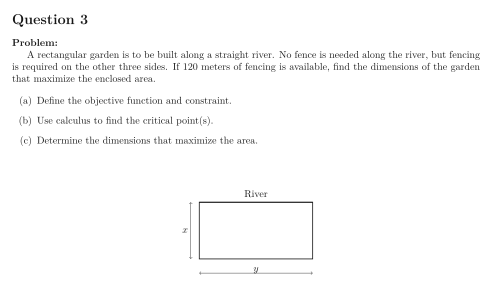
A rectangular garden is to be built along a straight river. No fence is needed along the river, but fencing is required on the other three sides. If 120 meters of fencing is available, find the dimensions of the garden that maximize the enclosed area.
(a) Define the objective function and constraint.
(b) Use calculus to find the critical point(s).
(c) Determine the dimensions that maximize the area.
See the diagram in the original worksheet below.
Show solutionHide solution
Question 3 - Solution
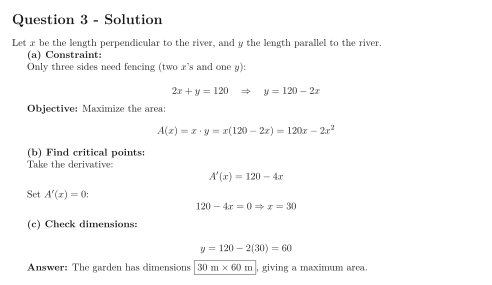
Let be the length perpendicular to the river, and the length parallel to the river.
(a) Constraint:
Only three sides need fencing (two ’s and one ):
Objective: Maximize the area:
(b) Find critical points:
Take the derivative:
Set :
(c) Check dimensions:
Answer: The garden has dimensions , giving a maximum area.