Derivatives of Trig Functions — Question 1

PDF ↗

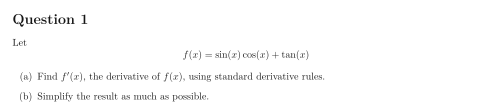
Question 1

Let f(x)=sin⁡(x)cos⁡(x)+tan⁡(x)f(x) = \sin(x)\cos(x) + \tan(x)

  • (a) Find f′(x)f'(x), the derivative of f(x)f(x), using standard derivative rules.

  • (b) Simplify the result as much as possible.
Original worksheet page 1: question and worked solution for 3-5-001
Show solutionHide solution

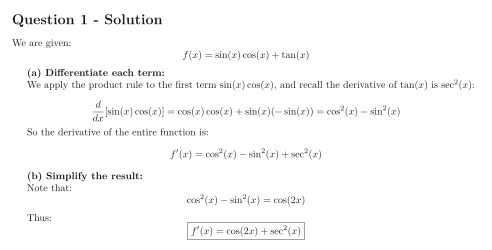
Question 1 - Solution

We are given: f(x)=sin⁡(x)cos⁡(x)+tan⁡(x)f(x) = \sin(x)\cos(x) + \tan(x)

(a) Differentiate each term:

We apply the product rule to the first term sin⁡(x)cos⁡(x)\sin(x)\cos(x), and recall the derivative of tan⁡(x)\tan(x) is sec⁡2(x)\sec^2(x):

ddx[sin⁡(x)cos⁡(x)]=cos⁡(x)cos⁡(x)+sin⁡(x)(−sin⁡(x))=cos⁡2(x)−sin⁡2(x)\frac{d}{dx}[\sin(x)\cos(x)] = \cos(x)\cos(x) + \sin(x)(- \sin(x)) = \cos^2(x) - \sin^2(x)

So the derivative of the entire function is: f′(x)=cos⁡2(x)−sin⁡2(x)+sec⁡2(x)f'(x) = \cos^2(x) - \sin^2(x) + \sec^2(x)

(b) Simplify the result:

Note that: cos⁡2(x)−sin⁡2(x)=cos⁡(2x)\cos^2(x) - \sin^2(x) = \cos(2x)

Thus: f′(x)=cos⁡(2x)+sec⁡2(x)\boxed{f'(x) = \cos(2x) + \sec^2(x)}

Original worksheet page 2: question and worked solution for 3-5-001

Original worksheet layout. Use Enlarge or open the PDF for a closer view.