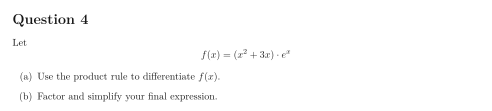
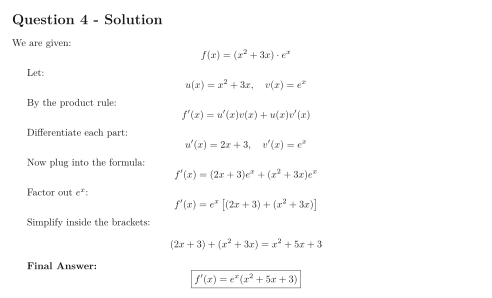
Question 4 Let f(x)=(x2+3x)⋅exf(x) = (x^2 + 3x)\cdot e^{x} (a) Use the product rule to differentiate f(x)f(x). (b) Factor and simplify your final expression. Show solutionHide solution+Question 4 - Solution We are given: f(x)=(x2+3x)⋅exf(x) = (x^2 + 3x)\cdot e^{x} Let: u(x)=x2+3x,v(x)=exu(x) = x^2 + 3x, \quad v(x) = e^{x} By the product rule: f′(x)=u′(x)v(x)+u(x)v′(x)f'(x) = u'(x)v(x) + u(x)v'(x) Differentiate each part: u′(x)=2x+3,v′(x)=exu'(x) = 2x + 3, \quad v'(x) = e^{x} Now plug into the formula: f′(x)=(2x+3)ex+(x2+3x)exf'(x) = (2x + 3)e^{x} + (x^2 + 3x)e^{x} Factor out exe^{x}: f′(x)=ex[(2x+3)+(x2+3x)]f'(x) = e^{x} \left[ (2x + 3) + (x^2 + 3x) \right] Simplify inside the brackets: (2x+3)+(x2+3x)=x2+5x+3(2x + 3) + (x^2 + 3x) = x^2 + 5x + 3 Final Answer: f′(x)=ex(x2+5x+3)\boxed{ f'(x) = e^{x}(x^2 + 5x + 3) }